

Scottish Vocational Qualification (SVQ)
SVQ – Scotland’s Work Based Qualification
A Scottish Vocational Qualification (SVQ) is a work-based qualification rooted in Scotland’s education framework that certifies an individual’s competence and practical ability to perform a specific job to national occupational standards.
1. What is an SVQ? (Definition & Scope)
SVQs are work-based credentials modeled on National Occupational Standards (NOS). They prove that a worker can perform their job effectively and safely within their industry. Rather than depending on written exams, they assess tangible performance, skills, and knowledge in real employment settings.
SVQ Levels and the SCQF Framework
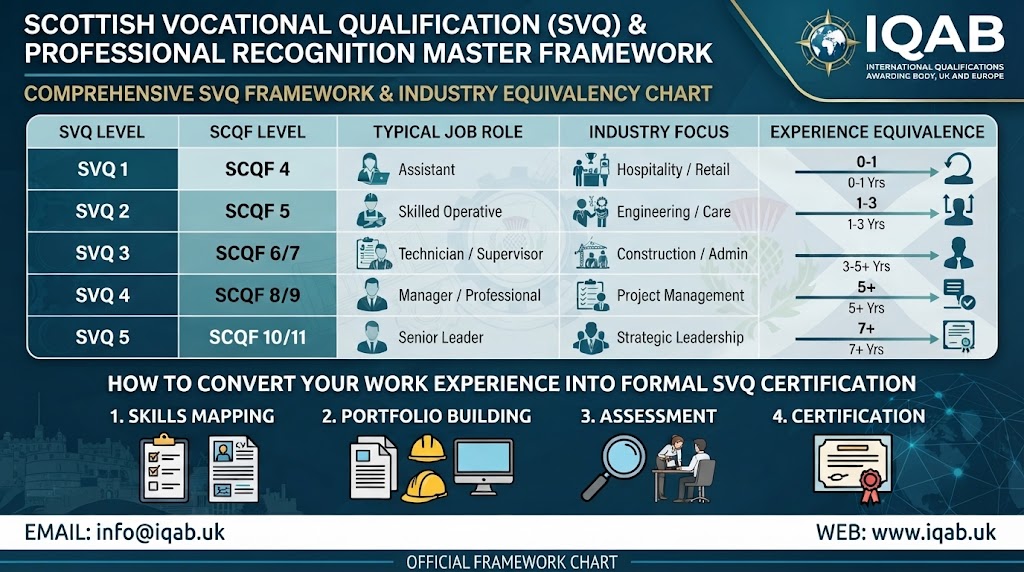
SVQs are mapped onto the Scottish Credit and Qualifications Framework (SCQF) across levels 4 through 11:
-
SCQF Levels 4–5 (Equivalent to SCQF Foundation/General): Focuses on routine work tasks and supervised execution.
-
SCQF Level 6–7 (Equivalent to Highers / Advanced Highers): Covers complex, non-routine tasks, independent work, and sometimes supervisory skills.
-
SCQF Levels 8–9 (Equivalent to HNC / HND): Geared toward technical specialisms, management, and higher-level professional capabilities.
-
SCQF Levels 10–11 (Equivalent to Bachelor’s / Master’s Degree level): Tailored for senior management, strategic directors, and high-level autonomous professionals.
2. Who is Eligible for SVQ Qualifications?
-
Employed Individuals: Workers looking to formalize their experience, upskill, or gain promotion.
-
Apprentices: Participants enrolled in Modern, Technical, or Professional Apprenticeship frameworks in Scotland.
-
Career Changers: Anyone who can secure access to a practical workspace environment to generate the necessary performance evidence.
-
Note: There are generally no strict academic entry barriers or age limits, though candidates must be in a job role or context that provides adequate exposure to realistic work activities.
3. Step-by-Step Assessment Process
SVQs rely entirely on portfolio evidence and practical demonstration rather than examination halls:
-
Initial Diagnostic & Induction: The candidate and assessor map current experience against the SVQ units to determine the right level.
-
Evidence Gathering: The candidate collects workplace proof (such as work products, digital logs, photos, witness testimonies, and job sheets).
-
Direct Workplace Observation: An assessor watches the candidate perform normal tasks naturally on the job.
-
Professional Discussion: The assessor quizzes the candidate to verify their underlying knowledge and understanding of “why” tasks are done a certain way.
-
Internal & External Verification: Centers review the portfolio internally, followed by sampling from the awarding body to confirm grading alignment.
-
Certification: Once all performance criteria are fulfilled, the formal qualification is awarded.
4. Assessor Responsibilities
Assessors are vital to maintaining the integrity of the vocational framework:
-
Mentorship & Planning: Guiding candidates on what types of evidence satisfy specific National Occupational Standards.
-
Objective Evaluation: Conducting structured workplace observations and professional discussions impartially.
-
Feedback & Judgment: Reviewing evidence files, offering constructive developmental feedback, and formally deciding whether a candidate is Competent or Not Yet Competent.
5. Scope of RPL (Recognition of Prior Learning) for SVQs
Yes, there is explicit scope to apply RPL for SVQs.
-
RPL allows candidates to use past learning, prior life experience, and historical work performance to claim credit for whole SVQ units or specific criteria.
-
If a candidate can convincingly demonstrate through documentation or professional discussions that they already meet the performance criteria and knowledge statements from previous employment, that evidence counts toward their qualification, cutting down duplicate effort.
6. How IQAB Assists Candidates
Organizations like IQAB (International Qualifications Awarding Body) support professional learners, centers, and international markets by maintaining strict quality benchmarks:
-
Pathway Guidance: Advising international or UK candidates on how to map their existing skills and prior learning (RPL) to equivalent framework structures.
-
Quality Assurance Support: Helping training providers streamline assessment designs, documentation tracking, and verification processes.
-
Global Credibility: Assisting professionals in showcasing certified competence, bridging cross-border employment standards.
APPLICATION FORM FOR SVQ ASSESSMENT, PLEASE SVQ Scotland Application Form (Microsoft Word Doc.)
Contact & Official Web Info:
Website:www.iqab.uk
Email:info@iqab.uk
Resources for Knowledge:
SVQ Explained — Levels, Assessment & Value | Scotland
Handbook in PDF below – A complete guide for Employers:
