

National Vocational Qualifications (NVQs) are work-based qualifications in the UK that certify an individual’s competence and practical ability to perform specific jobs to a nationally recognized standard. Unlike traditional academic study, NVQs focus on real-world capability and hands-on performance rather than written examinations.
NVQ is its assessment method, which is carried out in a real work environment or through simulations. Respective Candidates are not expected to sit exams. Instead, they demonstrate their individual ability to perform job-specific tasks consistently and competently.
1. What is an NVQ? (Definition & Scope)
An NVQ is a competency-based qualification built around national occupational standards. Candidates prove they can do their job effectively by gathering performance evidence directly from their workplace. They span numerous sectors—such as construction, health and safety, business administration, and management.
2. NVQ Levels and Academic Equivalents
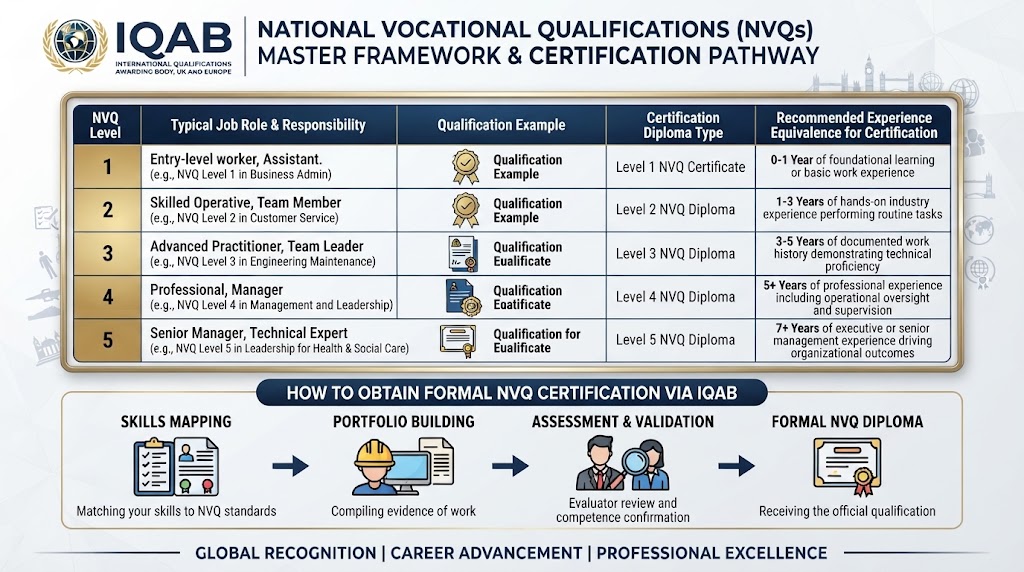
NVQs range from entry-level programs up to doctoral-equivalent standards.
-
Level 1: Focuses on basic work activities and routine tasks (Equivalent to GCSE grades 3–1 / D–G).
-
Level 2: Develops technical job-related skills for independent work (Equivalent to GCSE grades 9–4 / A*–C).
-
Level 3: Covers advanced responsibilities, complex work, and supervisory skills (Equivalent to 2 A-Levels).
-
Level 4: Geared toward advanced technical skills, junior management, and HNC-level knowledge.
-
Level 5: Designed for senior staff, middle management, and higher education diplomas (Equivalent to a Foundation Degree/HND).
-
Levels 6 & 7: Aimed at senior professionals, directors, and strategic leaders (Equivalent to Bachelor’s and Master’s degrees respectively).
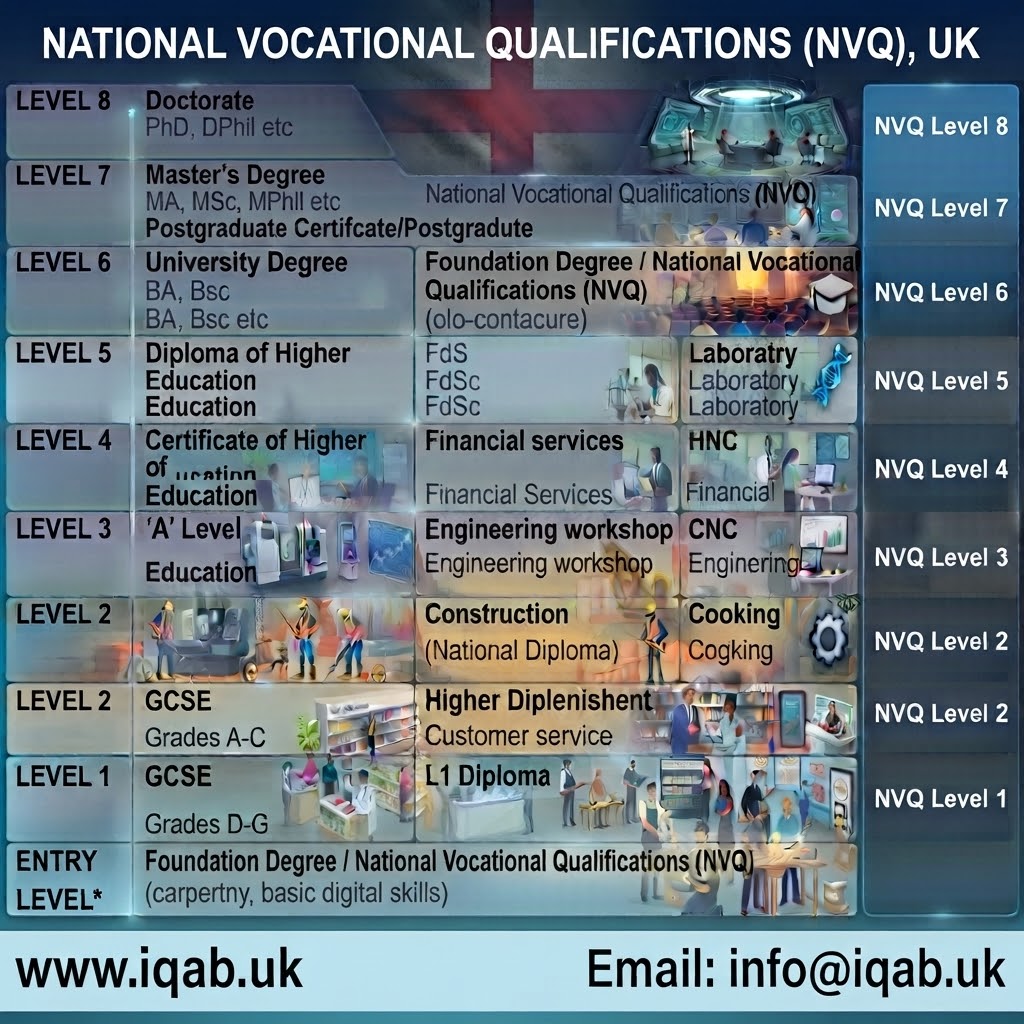
Here’s an level wise classification for the NVQ Awards:
3. Who is Eligible for NVQ Qualifications?
NVQs are uniquely flexible and inclusive:
-
Current Employees: Workers looking to formalize their experience or upskill within their current profession.
-
Apprentices: Individuals completing structured vocational training frameworks.
-
New Entrants / Career Changers: People starting fresh in an industry can take lower-level or entry-level paths, provided they have access to a practical learning environment or workplace context.
-
There are typically no strict academic entry barriers for lower levels; eligibility depends heavily on being in a job role (or having access to one) that allows you to fulfill the unit criteria.
4. How Long Does It Take to Complete an NVQ Qualification, UK?
The time of an NVQ depends on several factors, including the level of the qualification, the complexity of the role, and the time the learner can dedicate to develop their portfolio. Typically, lower-level NVQs (Level 1 or 2) may take between three to six months, while Level 3 and above can take up to 12 to 18 months to complete NVQ study/process.
Learners with adequate prior experience may progress faster, especially if they already possess evidence that meets the NVQ criteria. Some providers offer accelerated routes for experienced professionals through Recognition of Prior Learning (RPL).
5. Step-by-Step Assessment Process
NVQs do not feature traditional exam halls. Instead, assessment is continuous and evidence-driven:
-
Initial Assessment & Enrollment: Candidates map their current job role and experience against the appropriate NVQ level.
-
Portfolio Building: Candidates collect workplace evidence—such as photos, videos, witness testimonies, job sheets, and work products.
-
Workplace Observation: An allocated assessor observes the candidate performing real tasks in their day-to-day work environment.
-
Professional Discussion & Knowledge Questioning: Assessors test the candidate’s theoretical understanding behind practical processes.
-
Internal & External Verification: Completed portfolios are checked internally by the center and sampled externally to ensure grading consistency.
-
Certification: Once judged “Competent,” the official qualification certificate is awarded.
6. Assessor Responsibilities
Assessors play a crucial regulatory and supportive role in the NVQ journey:
-
Guidance & Mentoring: Helping candidates understand what evidence is required to meet national standards.
-
Objective Evaluation: Conducting fair, unbiased workplace observations and professional discussions.
-
Portfolio Review: Systematically reviewing submitted evidence files and providing constructive feedback.
-
Decision Making: Formally judging whether a candidate is “Competent” or “Not Yet Competent” based strictly on pre-set occupational standards.
7. How IQAB Assists Candidates ?
Organizations like IQAB (International Qualifications Awarding Body), UK and Europe support candidates and providers by upholding high benchmarking, transparent evaluations, and quality assurance frameworks:
-
Guidance & Pathway Alignment: Helping learners and training institutions align their professional competencies with structured quality benchmarks.
-
Quality Assurance Support: Ensuring that assessment processes, digital portfolio tracking, and verification mechanisms adhere to strict, reliable standards.
-
Global Recognition: Assisting professionals and providers in validating vocational excellence, transparency, and cross-border trust.
APPLICATION FORM FOR NVQ ASSESSMENT, PLEASE NVQ UK Application Form (Microsoft Word Doc.)
Contact & Official Web Info:
Website:www.iqab.uk
Email:info@iqab.uk
Sources for Knowledge: How to Apply for an NVQ National Vocational Qualification in the UK?
NVQ courses: what is a National Vocational Qualification?
